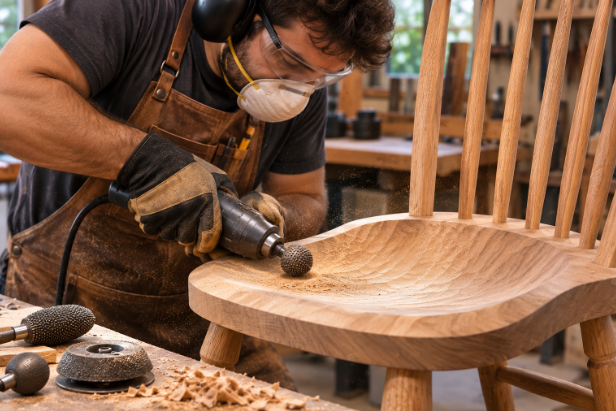
A well-made chair is judged by how it feels as much as how it looks. Flat boards and straight joinery create structure, but comfort comes from shaping. The scooped, flowing seat found on many stools and Windsor-style chairs is a classic example, and it takes planning, patience, and the right tools to get it right. Understanding saddle seat carving helps woodworkers move steadily from rough blanks to contoured surfaces with confidence. This guide explains what the technique involves, the tools commonly used, how to approach hardwoods, and which habits lead to clean, comfortable results that look as good as they feel.
What Defines a Saddle-Shaped Seat
A saddle seat has a dished center and gently raised edges, resembling the contour of a horse saddle. The shape supports the sitter and distributes pressure more comfortably than a flat board. Traditionally, chairmakers shaped these seats with hand tools such as adzes, scorps, and travishers. Today, many also use power tools to speed up rough shaping, then refine the surface by hand. Either route demands careful attention to depth, symmetry, and how the surface transitions toward the edges.
Where Power Carving Fits in the Workflow
Power carving fits naturally after parts are milled, cut, and assembled, when work shifts from fabrication to refinement. At that stage, it offers direct control over grain direction, depth of cut, and ergonomic shaping. Because the tools behave like rotary chisels, they bridge traditional machinery and hand-guided sculpting. They also soften hard edges, blend joints and seams, and fine-tune the feel of contact surfaces such as armrests and chair backs. Power carving does not replace traditional tools; it complements them.
Choosing the Right Tool for the Job
Different tools handle different stages. Shaping wheels used on an angle grinder remove material quickly and shape flowing forms. Contour wheels create concave hollows, rounded edges, and sculpted recesses, which suit dished surfaces. Rotary burrs add finer detail and texture, and hand rasps provide multi-directional control for refining by hand. For saddle seat carving, many makers rough out the dish with an aggressive wheel, then switch to finer tools for blending.
Working with Hardwoods
Hardwoods such as maple, walnut, oak, cherry, and mahogany respond well to power carving when the tools cut smoothly. Look for tools that avoid grabbing, perform cleanly in dense wood, and resist clogging, since resin and dust can build up during long sessions. Always read the grain before you begin. Working with the grain where possible helps prevent tear-out, while light passes let you control stock removal near the edges, where mistakes are hardest to correct.
Carving Compared with Sanding
Carving and sanding serve different purposes. Power carving removes material intentionally to create shape, while sanding only smooths what is already there. That is why heavy sanding is a poor way to form a seat contour: it is slow and offers little control over form. In saddle seat carving, shape first with carving tools, then sand to refine the surface before finishing.
Safety and Control Habits
Wear eye protection, a dust mask, and hearing protection, and clamp the workpiece firmly before starting. Dust control matters, since carving produces a lot of fine particles. Keep both hands behind the cutting area, let the tool do the work, and use light pressure instead of forcing it. Check compatibility before mounting any accessory, confirming that it suits your rotary tool, die grinder, or flex shaft and that the speed rating is respected.
Conclusion
Shaping a comfortable seat is a skill built through observation, patience, and the right equipment. Start by understanding the form, choose tools that match each stage, read the grain, and keep safety habits consistent. The same control carries into related crafts, including woodturning texturing, where rotary tools add decorative surface detail to turned pieces. Whether you work on a single stool or a full set of chairs, steady practice turns flat stock into furniture that invites people to sit.
