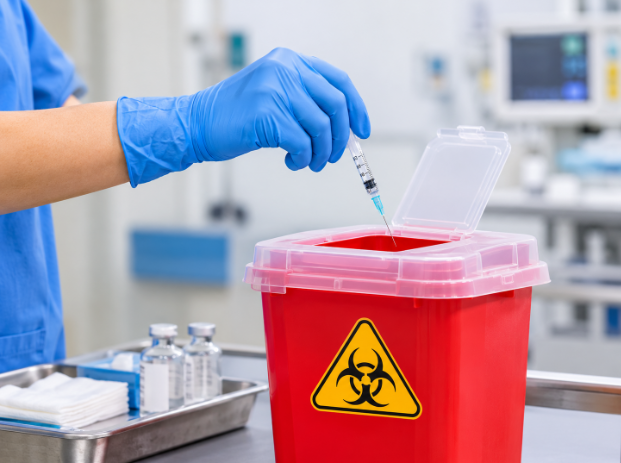
Every day, hospitals, clinics, dental offices, laboratories, and even households generate used needles, lancets, scalpel blades, and other sharp items. These objects can carry blood-borne pathogens and cause painful injuries long after they have left the treatment room. Proper waste management of sharps disposal reduces those dangers by controlling items from the moment of use until final treatment. Workers who handle trash, laundry, and recycling are often the ones hurt when sharps are hidden in the wrong bag. Understanding how containers, rules, and handling habits fit together helps facilities protect staff, patients, and the surrounding community. This article explains what counts as a sharp, how to contain and store it safely, and what happens after the container leaves the building.
What Counts as a Sharp and Why It Matters
Sharps include hypodermic needles, syringes with attached needles, insulin pen tips, lancets, scalpel blades, suture needles, and broken glass vials that have touched blood or body fluids. Even items without a needle, such as razor blades or glass slides, can puncture skin and spread infection. In the United States, the Occupational Safety and Health Administration requires employers to follow the Bloodborne Pathogens Standard, which calls for engineering controls, written exposure plans, training, and proper containers. Safer devices with retractable needles or shielded tips are encouraged because they lower the chance of accidental sticks. Used needles should never be recapped, bent, or broken by hand, and they should go into a container immediately after use. A solid waste management of sharps disposal therefore begins with training, since staff must recognize hazards and know the correct steps without hesitation. Rules differ by state and sometimes by city, so each facility should confirm requirements with its health or environmental agency. Employees who suffer a needlestick should wash the area, report the incident, and seek medical evaluation right away. Prompt reporting also helps managers learn what went wrong and prevent a repeat. Regular refresher sessions keep good habits fresh, especially when new staff or devices are introduced.
Containers, Labeling, and Safe Storage
Containers are the backbone of safe handling. A proper sharps container is rigid, puncture-resistant, leak-proof, and closable, with a clear label or symbol warning of biohazard risk. Many are red or carry the universal biohazard sign, and they should be placed at or near the point of use so that no one carries an exposed needle across a room. Mounting height matters, because containers set too high or too low are awkward to use and invite mistakes. For effective waste management of sharps disposal, containers should be replaced when they reach roughly three-quarters full, since overfilling forces hands close to protruding tips. Never push items down with fingers or try to retrieve something that has fallen in. Sealed containers belong in a secure storage area away from public access, protected from heat, moisture, and pests. Facilities should track how long full containers wait for pickup, because state rules often limit storage time. Households follow a simpler path, using an approved container or a sturdy plastic bottle with a screw cap, though local programs may specify what is allowed. Kitchen trash and recycling bins should never receive loose needles under any circumstance. Labels should include the date a container is closed so storage periods are easy to verify during inspections.
Conclusion
Once a container is sealed, it enters a tracked chain of custody. Licensed transporters collect it, carry it to a permitted facility, and provide documentation showing where it went. Treatment methods vary and may include autoclaving, incineration, or other approved processes that destroy infectious material before final disposal. Facilities often review their broader biomedical management waste procedures at the same time, since sharps, pathological items, and contaminated materials each follow different handling rules. Records should be kept for the period required by the state, and staff should know whom to contact when questions arise. Regular audits of container placement, training logs, and pickup schedules help catch weak points early. When every person understands the process, waste management of sharps disposal becomes a steady routine that protects workers, patients, and neighbors alike.
