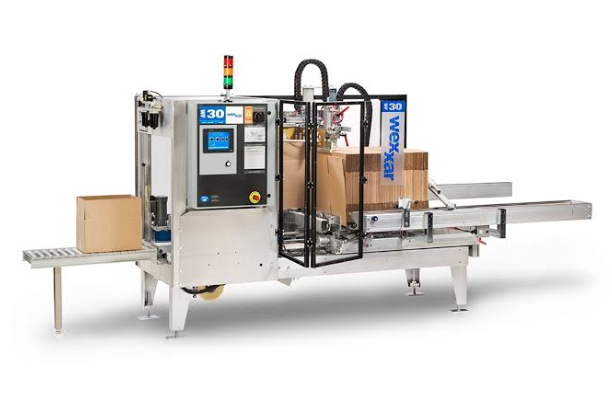
Efficient case forming is an important part of many packaging operations. Before products can be packed and sealed, corrugated cases need to be opened, squared, folded, and prepared for the next stage of production. Manual handling can make this process slower and less consistent, particularly when packaging lines operate at higher volumes. Automated equipment provides a way to make case preparation more predictable while reducing repetitive operator involvement.
A Wexxar case erector is designed for automated case forming and can be integrated into packaging lines serving different industries. Wexxar’s current range includes models such as the WF20, WF30, BEL 615, and BEL 625, offering different levels of automation and production capacity.
What Is a Wexxar Case Erector?
Wexxar’s WF series uses its patented Pin & Dome system to mechanically open and form cases. The technology is designed to provide consistent case formation without depending on continuous compressed air to hold the case during the forming process.
A Wexxar case erector is packaging equipment designed to take flat corrugated case blanks and form them into usable boxes. Depending on the model, the machine can handle case opening, squaring, flap folding, and sealing as part of the forming process.
How Does Automated Case Forming Work?
The case-forming process begins with flat corrugated blanks loaded into the machine’s magazine. The equipment advances individual blanks into the forming section, where mechanical systems open and square the case.
Once the case reaches the appropriate position, the machine folds the necessary flaps and prepares the box for sealing or packing. Depending on the equipment configuration, sealing can involve tape or hot-melt adhesive.
What Are the Benefits of Using a Wexxar Case Erector?
Wexxar case erector can provide several practical advantages for packaging operations.
Consistent Case Formation
Mechanical forming systems help maintain consistent case positioning and squaring. This can create a more reliable starting point for product loading and downstream sealing.
Improved Production Flow
Automated equipment can continuously prepare cases for the next packaging stage, reducing interruptions associated with manually opening and preparing boxes.
Reduced Manual Handling
Case erection involves repetitive movements that can require considerable operator involvement when performed manually. Automation can reduce these repetitive tasks and allow personnel to focus on other packaging responsibilities.
Flexible Production
Different Wexxar models are designed for different applications and production requirements. Features such as quick size changes can also make equipment more practical for operations handling multiple case sizes. The WF20, for instance, includes a tool-less size-change process designed to simplify adjustments.
How Does Maintenance Affect Case Erector Performance?
Regular maintenance helps packaging equipment operate consistently over time. Belts, bearings, rollers, fasteners, sensors, valves, and other mechanical or electrical components can all play a role in machine performance.
Inspection schedules should account for operating conditions, production volume, and manufacturer recommendations. Operators can also monitor changes such as unusual noise, inconsistent case squaring, delayed movement, or repeated jams, which may indicate that inspection or adjustment is needed.
Wexxar case erector provides dedicated parts and service support, while Machine Parts Toolbox lists a range of Wexxar components, including bearings, shafts, belts, pulleys, rollers, valves, and other replacement parts.
Selecting Equipment for Your Packaging Line
Choosing automated case-forming equipment should begin with a clear understanding of the production process. A line handling moderate volumes may have different requirements from a high-speed operation that needs continuous case preparation.
It is also important to consider how the Wexxar case erector will interact with conveyors, packing stations, case sealers, and other equipment. A properly matched system can create a smoother transition between case forming and subsequent packaging stages.
Conclusion
Automated case forming can improve consistency, reduce repetitive handling, and support smoother packaging workflows. Keeping compatible replacement components available is equally important for maintaining reliable performance. Whether replacing a worn part in a machine or planning packaging equipment, understanding the system’s requirements can help support efficient long-term operation.
