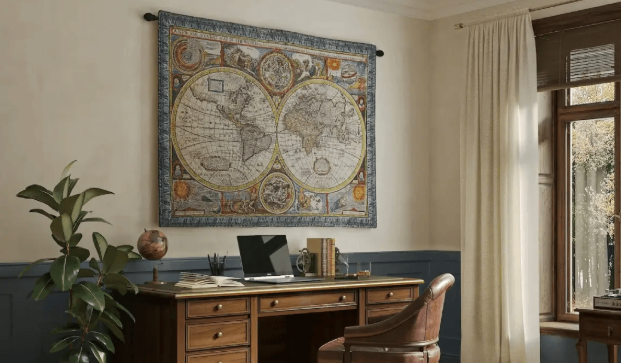
Creating personalized wall art can be a practical way to bring a meaningful image, artwork, photograph, or design into a room. Rather than selecting a finished piece from a standard collection, choosing to make your own tapestry allows the artwork, dimensions, colours, and overall presentation to be tailored to a particular space.
Custom woven tapestries can be used for family photographs, original artwork, historical images, business logos, decorative patterns, family crests, and other designs. The process requires more planning than purchasing ready-made wall décor, but understanding the major decisions can make the project easier.
What Does a Custom Tapestry Involve?
A custom tapestry starts with an image or artwork that is converted into a woven textile.
The image may be a photograph, digital illustration, painting, graphic design, family crest, or another piece of artwork. Quality Tapestries states that its custom service can work with common file formats including JPEG, PNG, TIFF, and PDF, while image resolution is also considered before weaving.
The final result differs from simply printing an image onto fabric. A woven tapestry uses threads to recreate colours, shapes, shading, and details within the textile itself.
Start With the Right Image
The source image has a major influence on the finished tapestry.
A high-resolution image generally gives the weaving process more information to work with. Detailed photographs should have sufficient clarity, especially when the final tapestry will be large.
When selecting an image, consider:
1. Overall resolution
2. Colour range
3. Contrast
4. Fine details
5. Subject placement
6. Background complexity
7. Intended tapestry dimensions
Quality Tapestries says that 72 dpi or higher is suitable for its weaving process, although the company notes that it has also worked with lower-resolution images.
If there is uncertainty about image quality, sending the original file for review can help determine whether it is appropriate.
Check Image Ownership
Copyright should be considered before turning an image into a custom textile.
If you created the artwork or photograph yourself, you generally have greater control over its use. Public-domain artwork can also be suitable, subject to confirming its status.
Images created by other artists, photographers, or organizations may be protected by copyright. Quality Tapestries states that customers must own the image or have appropriate rights to use it, and that copyrighted images may require a waiver.
This makes it important to establish image rights before beginning production.
Choose the Tapestry Dimensions
One of the biggest advantages of customization is the ability to select dimensions that suit the intended wall.
Before ordering, measure the available area and consider the furniture surrounding it. A tapestry above a sofa, bed, dining table, or console may need different proportions than one displayed on a completely open wall.
Quality Tapestries states that its widest loom has an output of 80 inches, while the other dimension can be longer. The company gives 80 by 200 inches as an example and notes that multiple pieces can potentially be used for larger areas.
Planning dimensions in advance can also help preserve the proportions of the original artwork.
Consider Horizontal, Square, or Vertical Designs
The orientation of the tapestry should complement the source image and the wall.
A landscape photograph may naturally work in a horizontal format. A portrait may be better suited to a vertical design, while a square composition can work for artwork created around a symmetrical subject.
Custom tapestry services can sometimes accommodate different shapes and orientations. Quality Tapestries states that custom pieces can be personalized in height, width, and shape, including horizontal, square, and vertical formats.
The correct orientation can make the final design feel more balanced.
Think About Colour
Colour reproduction is an important part of the customization process.
A photograph may contain many subtle tones, while a graphic design may rely on a smaller number of strong colours. Woven textiles interpret these colours through threads, which can give the final artwork a different appearance from the original digital image.
Before production, review the available preview or proof carefully.
Look for:
1. Skin tones
2. Dark areas
3. Highlights
4. Background colours
5. Fine colour transitions
6. Brand colours
7. Overall contrast
A proof can help identify unexpected visual issues before the tapestry is produced.
Understand Jacquard Weaving
Modern custom tapestries can use Jacquard weaving technology to reproduce detailed imagery.
Quality Tapestries states that its custom tapestries are woven on Jacquard looms. The company’s description explains that punched cards control individual threads, allowing detailed patterns and colour transitions to be reproduced within the textile.
This approach makes it possible to transform complex images into woven artwork rather than simply applying a printed image to fabric.
Consider the Fabric
The material affects the texture, weight, appearance, and durability of a custom tapestry.
Quality Tapestries currently states that its custom tapestries are approximately 65% cotton and 35% polyester. The company describes cotton as providing a soft, natural feel and polyester as contributing strength and durability.
The weight of a woven textile can also influence how it hangs on a wall. Before selecting a mounting method, check the final dimensions and material specifications.
Decide How It Will Be Finished
The back of the tapestry can be finished in different ways depending on how it will be displayed.
Quality Tapestries’ custom tapestry information describes options including a natural-coloured fabric lining and a rod pocket, while other finishing choices may also be available depending on the project.
Think about the intended installation before finalizing the order.
Possible display approaches can include:
1. A tapestry rod
2. Wall-mounted rails
3. A frame
4. Other appropriate textile mounting systems
Rods are not necessarily included with custom tapestry purchases, so this should be confirmed before ordering.
Prepare a Digital Proof
A digital preview provides an opportunity to review the proposed design before production.
Check the proof for composition, cropping, colour balance, dimensions, and important details.
If the tapestry will be particularly large, pay attention to how the image appears when expanded to the intended dimensions. A photograph that looks excellent on a computer screen may need different cropping or positioning to work well as a large wall textile.
Quality Tapestries states that customers can review a custom digital preview before finalizing an order.
Think About the Viewing Distance
The distance between the viewer and the tapestry affects how details are perceived.
A piece displayed across a large living room may be viewed from several metres away, while artwork in a hallway might be seen much closer.
Large-scale designs often benefit from strong overall composition because viewers may first see the complete image before noticing smaller details.
When choosing a photograph, consider whether the subject remains recognizable and visually balanced at the intended size.
Custom Tapestries for Personal Spaces
A personalized tapestry can be used to commemorate a person, place, event, or family history.
Examples include:
1. Wedding photographs
2. Family portraits
3. Travel photography
4. Pet portraits
5. Landscape photography
6.Family crests
7. Historical images
8.Original artwork
9. Children’s artwork
10. Personalized decorative designs
The textile format can make an ordinary digital image feel more like a permanent piece of interior artwork.
Custom Tapestries for Businesses and Organizations
Customization is not limited to residential décor.
Businesses, restaurants, galleries, schools, universities, and other organizations can use woven artwork for interior installations.
Potential applications include:
1. Company logos
2. Institutional crests
3. Historical imagery
4. Decorative installations
5. Exhibition artwork
6. Hospitality interiors
7.Branded wall décor
8. Large-scale artistic displays
Quality Tapestries states that it works with both individuals and major corporations and can produce single pieces as well as larger quantities.
For larger projects, consistency between multiple pieces becomes an important consideration.
Understand Production Time
Custom weaving requires more time than selecting a ready-made tapestry.
Quality Tapestries currently states that typical production takes around four to six weeks, while rush orders may sometimes be completed more quickly depending on the project. The company also notes that shipping can be expedited when needed.
Because production times can vary, custom orders should be planned well ahead of weddings, exhibitions, installations, renovations, or other fixed dates.
Ask About Pricing
Custom tapestry pricing can depend on size, design complexity, quantity, materials, finishing options, and shipping.
Quality Tapestries currently states that a single custom tapestry typically costs approximately 30–40 cents per square inch, with projects starting at $399. The company also notes that multiple-tapestry orders may receive different pricing depending on quantity.
These figures are provider-specific, so a current quotation is more useful than relying on a general price estimate.
Plan the Installation Before Ordering
A large tapestry should not be treated like lightweight paper artwork.
Before installation, consider the wall structure, mounting hardware, textile weight, and final dimensions.
Measure the installation area carefully and identify where the mounting hardware will be attached. If the tapestry is particularly large or heavy, appropriate professional installation may be worthwhile.
The mounting system should support the textile without creating unnecessary stress on the fabric.
Consider Care and Long-Term Display
Textile artwork should be protected from unsuitable environmental conditions.
Direct sunlight, moisture, dust, and improper storage can affect textiles over time. Consider the amount of sunlight that reaches the wall and whether the room has unusual humidity.
For pieces that are removed from display, store them according to the manufacturer’s recommendations. Rolling rather than tightly folding a large textile can help avoid permanent creasing, although the appropriate method depends on its construction.
Questions to Ask Before Ordering
Before starting a custom tapestry project, ask:
1. Is my image suitable for weaving?
2. What resolution is required?
3. Can the image be cropped?
4. What dimensions are available?
5. What materials will be used?
6. What finishing options are available?
7. Is a digital proof provided?
8. How long will production take?
9. Are rush orders available?
10. What mounting hardware is required?
11. Is the rod included?
12. How should the finished tapestry be cleaned?
13. What happens if the final piece differs from the approved proof?
Getting these details in writing can reduce misunderstandings and make the production process more predictable.
Conclusion
Choosing to make your own tapestry can turn a photograph, artwork, family image, or other meaningful design into a physical textile that can be displayed for years. The most important steps are selecting an appropriate source image, confirming image rights, choosing suitable dimensions, reviewing a digital proof, understanding materials and weaving techniques, and planning the final installation. For those interested in adapting a historic or mythical artwork into a personalized décor concept, a unicorn tapestry can also provide inspiration for how detailed imagery, symbolism, and woven texture can work together. Custom weaving allows the focus to remain on the artwork while adapting its dimensions and presentation to the intended space. With careful preparation and realistic expectations about production, customization can transform a digital image into a distinctive woven piece rather than simply another printed wall decoration.
