Losing a tooth can affect everyday activities, from enjoying meals to speaking comfortably. Over time, gaps in the smile may also affect confidence and oral health. Replacing missing teeth can help address these concerns, and dental implants are one option that dentists may recommend based on a patient’s individual needs.
For those exploring dental implants in Charlotte, NC, it is helpful to understand how implant treatment works, what determines eligibility, and what to expect throughout the process. Unlike conventional dentures or tooth-supported bridges, implants are placed in the jawbone to provide a foundation for replacement teeth. Treatment involves careful planning, a surgical procedure, and a period of healing before the final restoration is completed.
How Dental Implants Replace Missing Teeth
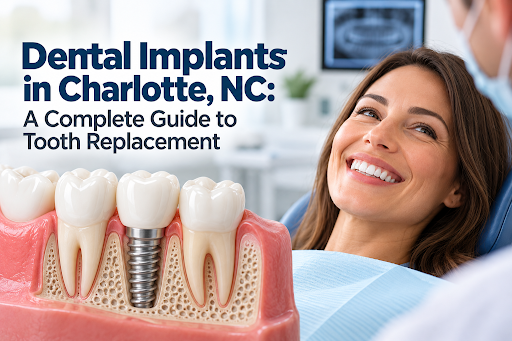
Dental implants are designed to replace the root of a missing tooth. A dentist or oral surgeon places a small implant post into the jawbone, where it gradually integrates with the surrounding bone. Once healing is complete, the implant can support a custom-made replacement tooth.
An implant restoration typically consists of three components:
- Implant post: The part placed within the jawbone that provides support for the restoration.
- Abutment: The connector that attaches the replacement tooth to the implant.
- Dental restoration: The visible portion, which may be a crown, bridge, or implant-supported denture.
The type of restoration depends on how many teeth are missing and the patient’s overall dental condition. A single implant can support an individual crown, while multiple implants may support a bridge or a full-arch restoration.
Because implants are anchored in the jawbone, they provide a different approach to tooth replacement than removable dentures, which rest on the gums, or traditional bridges, which generally rely on adjacent teeth.
Who Can Receive Dental Implants?
Dental implants may be suitable for adults who have lost one or more teeth, but eligibility depends on several clinical factors. A dental professional must assess the mouth and determine whether the available bone and surrounding tissues can support the planned restoration.
Important considerations include:
Jawbone volume and density: The implant needs sufficient bone for stable placement. If tooth loss has led to bone deterioration, a bone graft may be recommended to improve the available support.
Gum health: Healthy gums are important for successful treatment. Existing gum disease may need to be addressed before implant surgery can proceed.
Overall health: Certain medical conditions, medications, and factors that affect healing may influence the treatment plan. A complete medical history helps the dental team evaluate potential risks.
Oral hygiene habits: Patients need to maintain consistent oral care and attend follow-up appointments to protect the tissues surrounding the implant.
The evaluation may involve dental X-rays, three-dimensional imaging, and an examination of the remaining teeth and bite. Patients who have been missing teeth for several years may still qualify, although additional procedures could be necessary.
A personalised assessment is the most reliable way to determine whether dental implants in Charlotte, NC, are an appropriate option.
What Happens During Dental Implant Treatment?
Implant treatment is completed in stages, with the exact sequence and duration depending on the patient’s oral health and the complexity of the case.
- Consultation and treatment planning
The dental team examines the mouth, reviews medical and dental history, and assesses the jawbone. The dentist then develops a plan that accounts for the number of implants required, the type of restoration, and any preparatory treatment.
- Preparatory procedures, if needed
Some patients require a damaged tooth to be extracted before implant placement. Others may need treatment for gum disease or a bone graft to establish adequate support. Not every patient needs these additional procedures.
- Implant placement
During surgery, the implant post is positioned within the jawbone. The procedure is generally performed using local anaesthesia, with other comfort options considered when appropriate. The area then needs time to recover.
- Healing and bone integration
A process known as osseointegration allows the jawbone to bond with the implant surface. This stage is important for establishing a stable foundation. Cleveland Clinic notes that healing can take approximately three to nine months, although the timeframe varies with individual circumstances.
- Attachment of the replacement tooth
Once the implant is sufficiently stable, the dentist attaches the abutment and final restoration according to the treatment plan. The replacement tooth is checked for fit, appearance, and bite alignment.
Some patients may qualify for a different treatment sequence, including temporary teeth during healing. However, immediate placement or loading is not appropriate for every case.
Benefits of Dental Implants for Missing Teeth
Dental implants offer several potential advantages when compared with other tooth replacement methods. Their suitability depends on the patient’s dental condition and the restoration being considered.
- Improved chewing function: A properly restored implant can help patients bite and chew more comfortably.
- Natural-looking results: Custom crowns and other restorations can be designed to complement the colour and shape of surrounding teeth.
- Support for jawbone health: Implant placement can provide stimulation to the surrounding bone, helping limit the bone changes commonly associated with tooth loss.
- Preservation of adjacent teeth: A single implant can replace a missing tooth without requiring neighbouring healthy teeth to be reshaped for a conventional bridge.
- Fixed tooth replacement: Once the restoration is completed, it remains secured in place rather than being removed for daily use.
Implants can also support bridges or dentures when several teeth are missing. This flexibility allows dentists to plan treatment around different patterns of tooth loss.
Nevertheless, implants require surgery and ongoing care. Potential complications include infection, problems with healing, and issues involving the implant or surrounding tissues. A thorough consultation helps patients understand the likely benefits and risks before making a decision.
How Long Can Dental Implants Last?
Dental implants are intended to provide long-term support for replacement teeth. The implant itself may last for decades, and some implants remain functional for a lifetime. However, long-term success is not guaranteed, and the crown, bridge, or denture attached to the implant may need repair or replacement over time.
Several factors can influence durability, including gum health, oral hygiene, bite pressure, smoking, general health, and regular professional monitoring.
Patients should brush twice daily with fluoride toothpaste, clean carefully around the implant, and use suitable tools to remove plaque between the teeth. Routine dental visits allow the dentist to monitor the implant, examine the surrounding gums, and check the condition of the restoration.
Signs such as persistent pain, swelling, bleeding, or movement of the implant restoration should be evaluated promptly. Early assessment can help identify problems before they become more difficult to manage.
Cost and Other Considerations Before Choosing Implants
When researching dental implants in Charlotte, NC, patients should look beyond the initial procedure and consider the complete treatment plan. Costs vary depending on the number of implants, the type of restoration, the need for extractions or bone grafting, and the complexity of the case.
Insurance coverage also differs between plans. Some policies provide benefits for specific parts of implant treatment, while others may have exclusions, waiting periods, or annual benefit limits.
Before proceeding, patients may find it helpful to ask the dental provider:
- What is included in the estimated treatment cost?
- Will additional procedures be needed before implant placement?
- How long is the expected treatment and healing period?
- What temporary tooth replacement options are available?
- Which follow-up visits and maintenance procedures will be required?
- Are bridges or removable dentures reasonable alternatives?
Discussing these questions during the consultation can help clarify the financial commitment, treatment expectations, and available options.
Conclusion
Permanent dental implants offer a way to replace missing teeth with restorations supported by posts placed in the jawbone. Depending on the patient’s needs, treatment may involve a single crown, an implant-supported bridge, or a denture secured by multiple implants. Potential benefits include improved chewing, a natural-looking smile, and support for the jawbone following tooth loss.
For individuals considering dental implants in Charlotte, NC, the decision should begin with an evaluation of bone structure, gum health, medical history, and long-term oral care needs. Understanding the stages of treatment, possible additional procedures, costs, and maintenance requirements can help patients make informed choices.
A consultation with a qualified dental professional can establish whether implants are suitable and explain how they compare with other tooth replacement options. With appropriate treatment planning and consistent follow-up care, dental implants can provide a durable solution for many patients with missing teeth.
