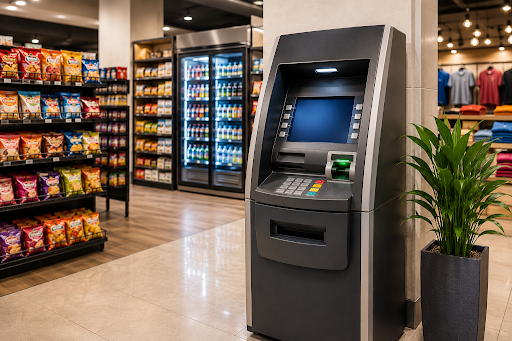
Not every ATM is the right ATM for every retail location. An atm for retailers selection involves matching the machine’s specifications, footprint, and capabilities to the specific requirements of the business — the available space, the expected transaction volume, the customer demographic, and the business owner’s preference for managing the machine versus outsourcing that responsibility. For retailers evaluating atm cash machines for sale in today’s market, understanding the key differentiators between models and procurement options leads to a decision that serves the business well for years.
Matching the Machine to the Location
An atm for retailers works best when its placement, size, and capabilities match the physical and operational characteristics of the location. A high-volume convenience store near a highway exit has different requirements than a neighborhood bar or a boutique retail shop. Volume drives cassette capacity requirements — a machine that needs to be refilled every two days is generating strong revenue but creating operational burden. A machine with a larger cash cassette capacity reduces the refill frequency and the associated labor cost.
Placement also affects machine selection. A freestanding indoor unit requires only power and network connectivity and can be positioned with flexibility within the retail space. A through-the-wall configuration requires exterior wall access and more complex installation but positions the ATM for dual use — serving both in-store customers and walk-up street traffic — which can significantly increase transaction volume.
Evaluating Atm Cash Machines for Sale
When reviewing atm cash machines for sale, the key evaluation categories are: compliance status, processing network compatibility, hardware condition and age, cassette capacity, screen interface, and serviceability. Compliance status — specifically EMV chip card capability and current PCI PED certification — determines whether the machine can be enrolled on the major processing networks and whether the owner bears liability for counterfeit card fraud.
Hardware condition and the availability of manufacturer support for replacement parts are important considerations when evaluating used atm cash machines for sale. Machines from brands with active parts distribution and documented service networks are significantly less risky than machines from discontinued product lines where replacement components must be sourced from secondary markets. Requesting a transaction history and maintenance log from the seller is a useful due diligence step.
New vs. Certified Refurbished ATMs
Retailers evaluating atm cash machines for sale have the option of purchasing new machines — which carry full manufacturer warranties and the latest compliance certifications — or certified refurbished units, which have been inspected, updated to current compliance standards, and warranted by the refurbisher. New machines offer the longest compliance horizon and the most predictable maintenance lifecycle. Certified refurbished machines offer a lower entry cost for retailers who want to start generating revenue before committing to the capital of a new unit.
The risk with uncertified used atm cash machines for sale is concentrated in the compliance dimension. An older machine that requires EMV or PED upgrades to be network-enrolled may cost more to bring into compliance than the initial purchase discount justifies. Clarifying the compliance status before any purchase is the most important due diligence step for any atm for retailers procurement.
Processing Network Selection
Every ATM requires a connection to a processing network to authorize transactions. The processing network selection determines which cardholders can use the machine, what the interchange fees are, and how quickly settlement funds are deposited. For most retail locations, enrollment in one of the major surcharge-free networks — Allpoint, MoneyPass — is a valuable option that increases the machine’s usefulness to a broader range of cardholders without eliminating the surcharge revenue from non-network cardholders.
An atm for retailers enrolled on multiple networks provides the broadest cardholder access and the most flexible surcharge structure. Processing network selection is typically facilitated through the ISO or processor that the retailer works with to deploy the machine, and comparing the interchange fee structures of available networks is a worthwhile step in the procurement process.
Ongoing Operational Responsibilities
Owning an atm for retailers means accepting ongoing operational responsibilities: cash replenishment, first-level troubleshooting, processing network compliance monitoring, and periodic hardware and software updates. These responsibilities are manageable for most business owners but should be factored into the total cost of ownership calculation when comparing owned atm cash machines for sale to placement or managed service alternatives.
ATM service providers offer maintenance agreements that cover periodic preventive maintenance and response to hardware failures — a practical investment for machines in high-traffic locations where downtime directly affects transaction revenue and customer satisfaction.
Conclusion
An atm for retailers is a revenue-generating asset when selected correctly and managed responsibly. Matching machine specifications to the location’s requirements, evaluating atm cash machines for sale with compliance status as the primary filter, choosing the right processing network, and planning for ongoing operational responsibilities are the steps that separate a well-considered deployment from a machine that sits idle or generates problems instead of revenue.
