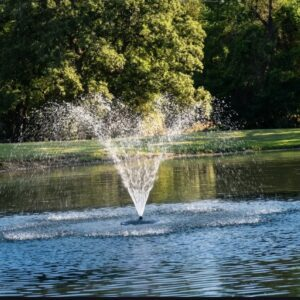
A pond can be transformed by adding moving water, but choosing the right equipment requires more than considering spray appearance. A floating water fountain combines a floating platform, pump, intake protection, nozzle system, electrical connection, and, in some configurations, an integrated lighting system. The equipment circulates pond water and sends it upward through interchangeable nozzles to create different visual patterns.
Understanding pump capacity, spray design, power requirements, installation components, and lighting options makes it easier to compare fountain systems for different ponds and water features. Current floating fountain systems are available in several horsepower and flow-rate configurations, including 1/3 HP at approximately 4,000 GPH, 1/2 HP at approximately 5,300 GPH, and 3/4 HP at approximately 6,600 GPH.
How Does a Floating Pond Fountain Work?
A floating water fountain operates from the surface of the pond rather than being permanently fixed to the bottom. Its pump draws water through an intake and pushes it upward through a nozzle. The nozzle determines how the water is distributed, creating the characteristic spray pattern.
The floating platform keeps the pump and nozzle assembly positioned at the water surface. Mooring ropes or anchor arrangements can be used to keep the fountain in its intended location while allowing it to accommodate normal changes in water level. Some complete fountain packages also include debris protection around the pump intake.
Water movement serves both functional and visual purposes. Pump circulation moves water through the fountain system while the spray introduces additional air-water contact. At the same time, the upward spray creates a visible centerpiece for ponds, lakes, landscaped water features, and other outdoor settings.
Pump Horsepower and Flow Rates
Pump capacity is one of the most important specifications when comparing fountain systems. Horsepower indicates the motor’s power rating, while gallons per hour (GPH) describes the approximate volume of water the pump can move.
Common configurations include:
1. 1/3 HP: approximately 4,000 GPH
2. 1/2 HP: approximately 5,300 GPH
3. 3/4 HP: approximately 6,600 GPH
These configurations provide different levels of water movement and spray performance. The appropriate option depends on the pond’s dimensions, desired spray characteristics, electrical setup, and overall installation requirements.
A larger motor is not automatically necessary for every installation. Instead, the pump should be considered alongside the pond’s size and the intended visual effect. Flow rate, nozzle configuration, and spray height all influence how the finished fountain appears.
Spray Nozzles and Water Patterns
Nozzles are responsible for shaping the water after it leaves the pump. Different nozzle designs can produce narrow vertical sprays, wider displays, tiered effects, or other patterns.
Many complete fountain systems include interchangeable nozzles rather than permanently fixed spray heads. For example, current floating fountain packages can include five interchangeable spray nozzles, allowing the same pump assembly to produce different water displays.
This modular approach is useful when the appearance of a pond needs to change without replacing the entire fountain. A narrower pattern may create a more concentrated vertical display, while a wider pattern can spread water across a larger area.
Floating Fountain Construction and Installation Components
A typical floating water fountain package contains several components that work together as a single system. The floating base supports the pump and nozzle assembly, while a power cable supplies electricity to the motor. Mooring equipment helps keep the fountain positioned within the pond.
A debris protection bag or screen can also be included around the pump intake. This component helps limit the amount of larger material entering the pump assembly. Complete systems may also include long electrical cords and mooring rope to simplify placement in larger outdoor water features.
Installation conditions still matter. The fountain should have adequate clearance for its spray pattern, suitable access to electrical power, and an appropriate anchoring arrangement. The surrounding landscape should also be considered so that water does not repeatedly overspray walkways, structures, or planted areas.
Lighted Floating Fountains
Lighting adds another dimension to fountain design by illuminating the spray after sunset. Lighted fountain systems can use several LED fixtures positioned around the fountain assembly so that water droplets and spray patterns become visible in low-light conditions.
Current lighted floating fountain configurations can include three LED fixtures operating at 12 volts with a combined 6-watt specification. Available lighting options can include white or color-changing illumination, depending on the system.
The relationship between nozzle design and lighting is important. A broad spray distributes illumination differently from a narrow vertical jet, so the same light system can produce different visual effects depending on the selected nozzle.
Choosing a Fountain for Different Pond Settings
The right floating water fountain depends on the pond’s dimensions, desired water display, available electrical supply, and intended operating environment.
For a smaller installation, a lower-horsepower system may provide sufficient circulation and visual movement without requiring the capacity of a larger motor. Larger ponds may require higher-flow configurations to achieve the desired display and water movement.
The visual objective also matters. A simple fountain without lighting can provide a daytime focal point, while a lighted configuration can extend the display into the evening. Current fountain ranges commonly provide multiple horsepower choices and both lighted and non-lighted versions.
Before installation, it is useful to consider the fountain’s spray diameter, operating depth, electrical requirements, anchoring method, and maintenance access.
Maintenance Considerations
Routine inspection helps preserve consistent fountain performance. One of the simplest checks is observing the spray pattern. A sudden reduction in height, uneven spray, or pulsing output can indicate debris around the intake or nozzle.
The fountain’s position should also be checked periodically. Changes in anchor tension, wind, or other outdoor conditions can cause a floating unit to move from its intended location. Maintenance guidance for floating fountains commonly recommends inspecting the spray pattern, fountain position, anchor lines, and intake area.
Nozzles and pump intake areas may require cleaning when debris or mineral deposits affect water flow. The exact maintenance schedule depends on the pond environment, water conditions, and operating frequency.
Comparing Fountain Features Before Installation
When comparing systems, it helps to evaluate the specifications as a complete package rather than focusing on horsepower alone. Important factors include:
1. Pump horsepower and GPH rating
2. Number and type of interchangeable nozzles
3. Floating base construction
4. Electrical voltage and cord length
5. Debris protection
6. Mooring or anchoring equipment
7. Optional or integrated LED lighting
8. White versus color-changing illumination
9. Access to replacement components
10. Maintenance requirements
A well-matched system balances water movement with the desired spray appearance and installation conditions.
Conclusion
A floating water fountain is a combination of pump technology, floating construction, nozzle design, and electrical components that creates both water movement and a defined visual display. Different horsepower ratings, flow rates, spray patterns, and lighting configurations allow fountain systems to be adapted to a range of pond environments. For installations that operate after sunset, outdoor fountain lighting can complement the spray by illuminating the water pattern and changing the appearance of the feature after dark. The most practical selection ultimately depends on pond dimensions, desired spray style, power requirements, installation layout, and maintenance access rather than appearance alone.
