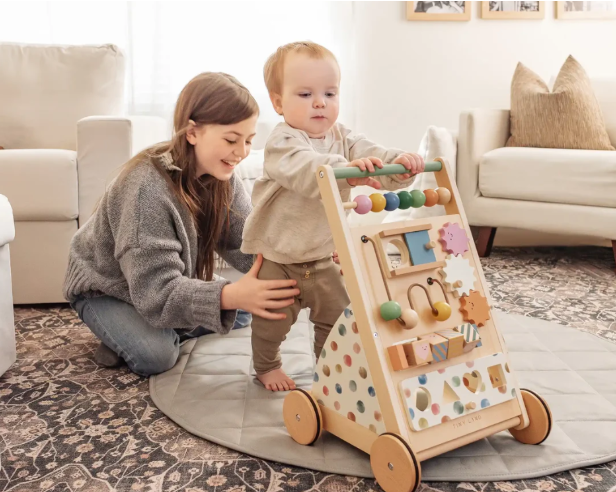
Choosing toys for babies and toddlers involves more than finding something colorful or entertaining. At this stage, toys can provide opportunities for children to explore movement, problem-solving, imagination, and interaction with caregivers. Wooden toys have remained a popular choice because many simple designs encourage children to actively participate in play rather than simply watch or listen to a toy.
From stacking blocks and shape sorters to puzzles and pretend-play objects, traditional toys can support different types of play. The American Academy of Pediatrics notes that toys should match a child’s developmental abilities and encourage opportunities to develop new skills, while simple toys can also encourage interaction between children and caregivers.
What Are Wooden Toys?
Wooden toys are children’s play objects made primarily from wood, although some may incorporate other materials such as fabric, rope, metal, or non-wooden components. They can range from very simple blocks to more complex puzzles, vehicles, stacking sets, and pretend-play accessories.
The appeal of wood partly comes from its physical properties. A solid wooden object can have a different weight, texture, sound, and resistance compared with a lightweight plastic toy. These sensory differences can make basic activities such as stacking, sorting, pushing, pulling, and fitting pieces together more engaging.
However, the material itself does not automatically make a toy appropriate or safe. Age suitability, construction, coatings, small parts, and intended use all need to be considered.
What Developmental Skills Can Wooden Toys Encourage?
One advantage of simple wooden toys is that they often leave room for children to determine how they want to play. A set of blocks, for example, can become a tower, a road, a house, or another imaginative creation.
Fine Motor Skills
Activities such as stacking, fitting, threading, or manipulating appropriately sized pieces can require controlled hand and finger movements. Repeated practice can give children opportunities to develop coordination.
Problem-Solving
Puzzles, shape sorters, and construction toys can introduce basic concepts such as matching, spatial relationships, balance, and sequencing.
Imaginative Play
Simple objects can be incorporated into pretend scenarios. The American Academy of Pediatrics emphasizes the value of traditional symbolic and pretend-play toys because they provide opportunities for children to use language, stories, and imagination.
Social Interaction
Toys do not have to be designed specifically for group play to encourage social development. Parents, siblings, and caregivers can participate by taking turns, building together, asking questions, or creating stories around the activity.
Why Are Simple Toys Often Useful for Young Children?
A toy does not need to have numerous electronic features to be engaging. In fact, traditional toys can encourage children to decide what to do with them.
A set of blocks, for instance, has no single required outcome. Children can experiment with different arrangements and discover what happens when structures become taller, wider, or unbalanced.
This open-ended quality can also make toys adaptable as a child develops. A basic construction set may initially be used for grasping and stacking, and later become part of more elaborate imaginative or building activities.
The important factor is not whether a toy is made from wood or another material, but whether it is appropriate for the child’s abilities and provides a suitable opportunity for play.
How Do You Choose Safe Wooden Toys?
Safety should always be considered when purchasing wooden toys, particularly for babies and toddlers who frequently explore objects by putting them in their mouths.
The U.S. Consumer Product Safety Commission advises parents and caregivers to follow age recommendations and select toys according to a child’s interests and abilities. It also warns that small parts can create choking hazards for children under three.
Before choosing a toy, check the following:
1. Age recommendation: Make sure the toy is suitable for the child’s age and developmental stage.
2. Small components: Avoid toys containing small pieces when they are not appropriate for the child’s age.
3. Construction: Check that pieces are firmly attached and that the toy does not have damaged components.
4. Edges and points: Inspect the surface for sharp or hazardous areas.
5. Finish: For painted or coated toys, check relevant safety information and use instructions.
6. Instructions: Follow assembly, cleaning, and supervision requirements.
The CPSC specifically states that children’s toys are subject to safety requirements and that toys intended for children under three can be subject to strict small-parts restrictions.
What Types of Wooden Toys Suit Different Ages?
Not every toy is suitable for every developmental stage. Infants may benefit from simple, appropriately sized objects that are easy to grasp, while older toddlers can interact with more complex construction, sorting, and pretend-play toys.
For younger children, large, uncomplicated designs can be preferable because they reduce the potential for small-part hazards. As children become more capable, puzzles, building sets, shape-matching activities, and imaginative-play objects can provide increasingly complex challenges.
Age labels should not be treated as the only consideration. A child’s individual abilities also matter. The American Academy of Pediatrics recommends considering whether a toy matches the child’s developmental level and skills.
How Can Wooden Toys Fit Into a Playroom?
A thoughtfully arranged collection of wooden toys can make a play area easier to navigate. Instead of keeping every toy available simultaneously, caregivers can organize items by activity.
For example, building pieces can be stored together, while puzzles and matching activities can have their own space. Pretend-play objects can be grouped separately.
This type of organization can help children see their options and return items after play. Storage should also be stable and appropriate for the child’s age, particularly when heavier objects are involved.
A playroom does not need to be filled with toys. A smaller collection of versatile items can provide opportunities for construction, imaginative play, sorting, movement, and interaction.
How Should Wooden Toys Be Maintained?
Regular inspection is important. Check toys periodically for cracks, splinters, loose components, damaged finishes, or pieces that have become detached.
Cleaning instructions vary according to the materials and finish. Excessive moisture can affect some wooden products, so caregivers should follow the manufacturer’s cleaning recommendations rather than soaking wood toys unnecessarily.
Damaged toys should not continue to be used if the damage creates a safety concern. The CPSC recommends regularly examining toys for sharp edges, missing pieces, or other problems that could create hazards.
Are Wooden Toys Always Safer Than Plastic Toys?
It would be inaccurate to assume that wood automatically makes a toy safer. Safety depends on design, construction, materials, age grading, and how the toy is used.
A poorly constructed wooden toy can still have sharp edges, loose pieces, or choking hazards. In fact, the CPSC issued a 2025 warning involving certain wooden bead toys intended for children under three because their small beads presented a choking hazard.
Therefore, parents should evaluate individual toys rather than choosing solely according to material.
Conclusion
Wooden toys can provide children with opportunities for hands-on exploration, construction, sorting, problem-solving, imaginative play, and interaction with caregivers. Their simple designs can encourage children to actively participate in play instead of relying entirely on automated features. When selecting playroom toys, safety and developmental suitability should remain the main priorities. Parents and caregivers should check age recommendations, inspect construction, avoid inappropriate small parts, and consider whether each toy matches the child’s current abilities. With thoughtful selection and regular maintenance, traditional wooden playthings can become useful additions to an environment designed for exploration, creativity, and shared play.
