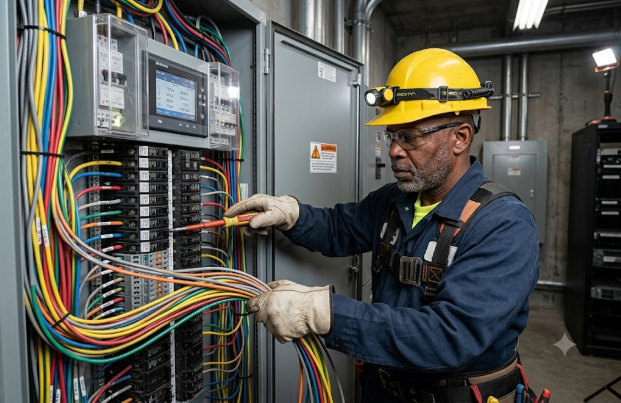
Electrical panels are among the most important components of a home’s electrical system. They distribute incoming electricity across individual circuits and provide protection through circuit breakers. As household electrical demand increases, an older panel may have limited capacity, insufficient breaker space, or components that have deteriorated over time. Understanding when electrical panel replacement may be appropriate can help homeowners make informed decisions before adding major appliances, renovating a property, or addressing recurring electrical problems.
What Does an Electrical Panel Do?
An electrical panel replacement receives electricity from the utility service and distributes it throughout a property through branch circuits. Each circuit supplies specific areas or equipment, while circuit breakers are designed to interrupt the circuit when excessive current occurs.
The panel’s amperage rating describes the amount of electrical current the service equipment is designed to handle. Common residential ratings include 100, 150, and 200 amps, although larger services are also used when a property’s calculated electrical demand requires them.
Importantly, a panel’s rating does not indicate how much electricity a household continuously consumes. Instead, electrical professionals consider the expected load when determining whether the existing service has enough capacity.
Signs That a Panel May Need Replacement
Not every electrical problem requires a complete electrical panel replacement, but certain conditions justify an inspection. Homeowners should pay attention to warning signs such as frequent breaker trips, unusual sounds, burning odors, visible corrosion, damaged components, or discoloration around breakers.
Limited breaker space can also become an issue when homeowners want to install new circuits. However, empty spaces and electrical capacity are two different considerations. A panel may have room for additional breakers but still lack enough overall capacity to support new high-demand equipment. The Department of Energy’s home electrification guidance specifically distinguishes physical panel space from available electrical capacity.
An electrician can determine whether the problem involves the panel itself, an individual circuit, connected equipment, or the overall service.
Why Electrical Demand Is Increasing
Modern households often rely on more electrical equipment than older homes were originally designed to accommodate. Common additions include electric vehicles, heat pumps, electric water heaters, induction cooking appliances, pool equipment, additional HVAC systems, and home workshops.
The Department of Energy notes that panel limitations can become relevant when homeowners add equipment such as heat pumps and other electrification technologies.
This does not mean that every new appliance requires a larger panel. The existing service may have sufficient capacity, or alternative solutions may be available. A load assessment helps determine the actual requirement.
When Is a 200-Amp Panel Upgrade Appropriate?
A 200-amp upgrade can be relevant when homeowners are undertaking substantial renovations or adding multiple high-demand electrical systems. For example, a property with central air conditioning, electric cooking, an EV charger, and electric water heating may have considerably different requirements from a home with fewer major electrical loads.
The correct service rating should be determined through an electrical load calculation rather than selected simply because 200 amps is a common residential rating.
How Load Calculations Help Determine Capacity
A load calculation evaluates the electrical demand expected from a property. It can account for existing appliances, heating and cooling systems, general household loads, and planned additions.
The Department of Energy’s panel-upgrade guidance explains that residential panel sizing can be evaluated using methods established by the National Electrical Code. It also notes that utility records can sometimes be used to help establish existing demand.
This assessment is important because adding up the ratings of individual circuit breakers does not accurately determine whether a service is overloaded. Breakers can collectively have ratings greater than the service rating because actual appliance demand is evaluated differently.
What Is Involved in Panel Replacement?
A panel replacement can range from replacing the panelboard itself to a more extensive service upgrade. The scope depends on the property’s existing equipment and the reason for the project.
An electrician may inspect the main breaker, service conductors, grounding and bonding, meter equipment, branch circuits, and panel enclosure. If the service capacity is being increased, associated components must also be suitable for the new rating.
In Arizona, utility requirements can form part of the process. Arizona Public Service states that service entrances being upgraded by increasing main-breaker ampacity must be brought up to current code and specification requirements. APS also requires customers to coordinate with the utility for applicable service changes and inspections.
Permits and inspections may also be required depending on the property’s location and the scope of work.
Replacement Versus Adding More Breakers
Installing additional breakers is not the same as increasing electrical service capacity. Breakers protect individual circuits, while the main service determines the amount of electrical power that can be supplied to the property.
For example, a homeowner may have unused spaces in a panel and assume that additional appliances can simply be connected. However, if the calculated load approaches or exceeds the service’s available capacity, additional circuits alone may not solve the problem.
On the other hand, a panel with limited physical space may have adequate electrical capacity but require a different configuration. An inspection can help determine which situation applies.
Planning for Future Electrical Needs
Panel replacement can also be an opportunity to consider realistic future electrical requirements. Homeowners may anticipate installing an EV charger, heat pump, electric water heater, solar system, battery storage, or additional HVAC equipment.
Planning for these loads during an electrical assessment can help determine whether the existing service will remain adequate. However, selecting a larger panel than necessary can introduce additional costs and requirements without providing a meaningful benefit.
The objective should be to match the electrical service to both present demand and reasonably foreseeable future needs.
Why Professional Assessment Matters
Electrical panel work involves components that can carry substantial current, making improper installation a serious safety concern. A qualified electrical professional can evaluate the complete system rather than focusing only on the visible panel.
An assessment can identify overloaded circuits, deteriorated components, grounding concerns, inadequate conductors, or other conditions that may affect the safety and performance of the electrical system.
Utility requirements must also be considered. APS provides detailed service requirements covering areas such as metering, grounding, bonding, equipment clearances, and service upgrades.
Conclusion
An electrical panel should be evaluated based on its condition, available capacity, existing electrical demand, and planned future equipment. Warning signs such as repeated breaker trips, overheating, corrosion, or inadequate capacity should be professionally investigated rather than addressed by simply adding more breakers.
For homeowners considering a 200 Amp Panel Upgrade, the appropriate solution depends on the property’s calculated electrical load and the requirements of the existing service and utility. A thorough evaluation can help establish whether a complete panel replacement, service upgrade, circuit modification, or another electrical solution is appropriate.
