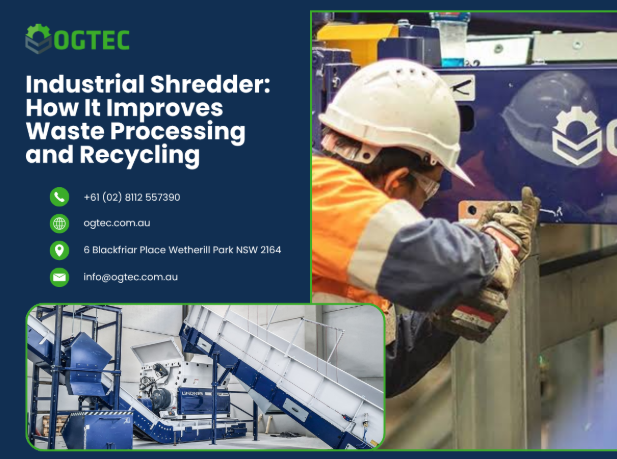
Modern waste management depends on more than simply collecting and transporting discarded materials. Facilities must process increasingly diverse waste streams efficiently while recovering materials that can be reused, recycled, or converted into alternative resources. Size reduction is an important stage because bulky or irregular materials can be difficult to sort, transport, and process in their original form. An industrial shredder helps address this challenge by reducing waste into more manageable fractions that can move through subsequent processing stages. Depending on the application, shredders may handle materials such as timber, plastics, commercial and industrial waste, construction waste, tyres, and mixed municipal waste.
What Is an Industrial Shredder?
The shredding process typically uses rotating shafts, cutting tools, knives, or other mechanical components to break material apart. The resulting output can then be transported, screened, separated, or subjected to additional size-reduction processes.
An industrial shredder is heavy-duty processing equipment designed to reduce large, bulky, or difficult materials into smaller pieces. Unlike small-scale shredders used for office or household applications, industrial machines are engineered for continuous or high-volume processing and demanding operating conditions.
The appropriate machine depends on factors such as the material being processed, required throughput, desired output size, contamination levels, and the role of the shredder within the wider processing line.
How Does Industrial Shredding Support Recycling?
Size reduction can make downstream recycling processes more manageable. Large materials can create blockages, occupy excessive space, or be difficult for sorting equipment to process consistently. Reducing them to a suitable size allows other equipment to perform more effectively.
For example, a recycling line may use shredding before screening and sorting. Screens can separate material according to size, while magnets can recover ferrous metals and optical sorting systems can identify particular material types. This means an industrial shredder is often one component within a larger material-recovery system rather than an isolated machine.
Which Materials Can Industrial Shredders Process?
Different materials place different demands on equipment. Tough or bulky feedstock may require high torque and robust cutting components, while applications requiring a more consistent particle size may place greater emphasis on screening and secondary processing.
The capabilities of an industrial shredder vary according to its design, cutting system, drive configuration, and application. Common industrial waste streams can include plastics, timber, commercial and industrial waste, construction and demolition materials, tyres, and mixed municipal waste.
For this reason, equipment selection should begin with an assessment of the actual feedstock rather than choosing a machine solely according to its nominal capacity.
What Should Facilities Consider Before Choosing a Shredder?
The position of the shredder within the overall plant is equally important. Conveyors, screens, magnets, windshifters, optical sorters, and balers may all form part of a broader processing system. Poor coordination between these stages can limit the performance of otherwise capable equipment. Effective Recycling solutions therefore depend on coordinating size reduction with other processing stages. The objective is not simply to make waste smaller but to create a controlled material stream suitable for recovery, further processing, or an appropriate end use.
Safety and maintenance requirements should also be considered during plant design. Regular inspection of wear components, cutting systems, drives, and other critical equipment can help support reliable operation and reduce avoidable downtime.
Conclusion
Efficient waste processing requires equipment that matches the material, throughput, and desired recovery outcome. When integrated correctly with conveyors and sorting technologies, shredding can improve material flow and support more effective resource recovery. For organisations evaluating equipment and system requirements, Ogtec can provide relevant information about industrial shredding and broader waste-processing applications.
