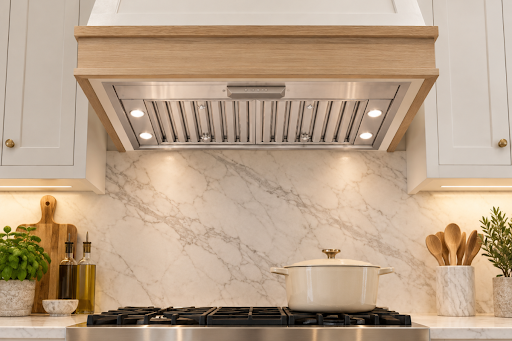
Kitchen ventilation often gets overlooked until smoke, grease, or lingering cooking odours become a daily annoyance. For homeowners with mid-to-large kitchens, a properly sized ventilation system makes a noticeable difference in air quality and comfort. A 36” hood vent kitchen setup is a common choice for ranges and cooktops in this size range, offering enough coverage to capture smoke and airborne grease without overwhelming the space visually. Before choosing one, it helps to understand how these hoods function, what sizing considerations matter, and how airflow ratings affect day-to-day cooking performance.
Why Hood Size Matters for Ventilation Efficiency
Range hood sizing isn’t just about matching the width of a cooktop. Ventilation experts generally recommend that a hood extend slightly beyond the edges of the cooking surface on both sides, which helps capture rising heat, steam, and grease particles that might otherwise escape around the edges. For a standard 36-inch range or cooktop, a hood of the same or slightly wider width is typically recommended to ensure full coverage across all burners.
Coverage isn’t the only factor, though. Mounting height also plays a role in performance. Hoods installed too high above the cooking surface lose much of their capturing efficiency, while those mounted too low can interfere with cooking or become a safety concern near open flames.
Understanding CFM Ratings
CFM, or cubic feet per minute, measures how much air a range hood can move. This rating is one of the most important specifications to consider, as it directly affects how effectively a hood clears smoke and odours from the kitchen. For a 36” hood vent kitchen, higher-output cooking, such as high-heat searing or wok cooking, generally requires a hood with a higher CFM rating compared to everyday simmering or baking-adjacent cooking tasks.
For most residential kitchens, a general guideline is that gas ranges require higher CFM output compared to electric ranges, since gas burners produce more heat and combustion byproducts. Manufacturers often list recommended CFM ranges based on burner output, which can help narrow down suitable options.
Ducted vs. Ductless Options
Range hoods generally fall into two categories: ducted and ductless. Ducted hoods vent air directly outside the home through ductwork, removing smoke, grease, and odours entirely from the indoor environment. For a 36” hood vent kitchen, a ducted system can be particularly effective when the layout and existing ventilation infrastructure allow for exterior venting. Ductless hoods, on the other hand, recirculate air through filters that trap grease and, in some cases, odours, before releasing the filtered air back into the kitchen.
While ducted systems are generally considered more effective at fully removing airborne particles, ductless options can be a practical alternative in kitchens where running exterior ductwork isn’t feasible. The choice between the two often depends on the kitchen’s layout, the home’s existing ventilation infrastructure, and personal preference.
Noise Levels and Everyday Use
Noise output, measured in sones, is another factor worth considering. A hood that performs well on paper but produces excessive noise at higher fan speeds may end up underused, reducing its overall effectiveness. Many homeowners find a balance between airflow performance and noise level by choosing a hood with multiple fan speed settings, allowing lower noise operation for light cooking and higher power when needed.
Final Thoughts
Selecting the right ventilation setup involves more than picking a hood that fits the width of a cooktop. Considering CFM output, duct configuration, mounting height, and noise levels all contribute to a system that performs well over time. For those ready to move forward with a purchase, learning how to install a vent hood correctly is just as important as choosing the right model, since proper installation directly affects how well the unit performs once it’s in daily use.
