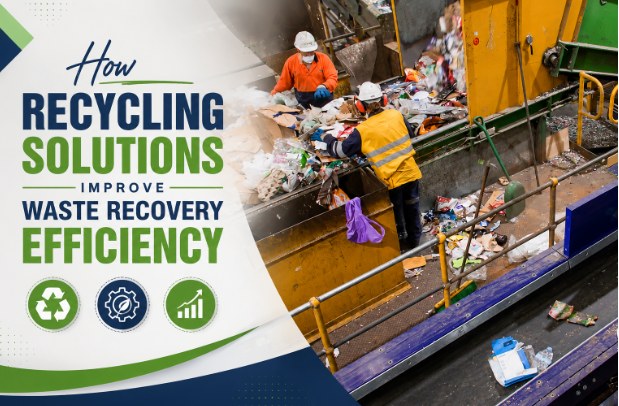
Waste management has evolved from simply collecting and disposing of unwanted materials to recovering as much usable material as possible. Businesses, manufacturers, municipalities, and recycling facilities increasingly need systems that can separate mixed waste, reduce contamination, and prepare recovered materials for further processing. Modern recycling solutions combine mechanical separation, size reduction, screening, optical detection, metal recovery, and automated handling to make these processes more efficient. When properly designed around a facility’s waste stream, these systems can improve material purity, reduce the amount sent to landfill, and make recovered commodities more suitable for reuse in manufacturing.
What Are Modern Recycling Solutions?
Modern recycling solutions are integrated processes designed to identify, separate, clean, resize, and prepare waste materials for reuse or further processing. A system may include several pieces of equipment rather than relying on a single machine.
The exact configuration depends on the materials being handled. Facilities processing plastics may need shredders, washing equipment, granulators, and optical sorters, while mixed municipal or commercial waste facilities may rely more heavily on screens, magnets, air separation, and automated sorting.
Different waste streams require different treatment methods because paper, plastic, metals, glass, organics, textiles, and construction waste have distinct physical properties. Effective system design therefore begins with understanding the incoming material composition, expected throughput, contamination level, and desired recovered products.
How Does Waste Sorting Improve Material Recovery?
Sorting is one of the most important stages in the recycling process because recovered materials generally become more useful when different material types are separated.
Modern recycling sorting systems can combine several technologies. Screens may divide materials according to size, while ballistic separators can distinguish flatter materials such as paper from three-dimensional containers. Magnetic separators recover ferrous metals, and eddy current systems can separate non-ferrous metals such as aluminium. Optical sorting equipment can identify materials based on properties such as colour or composition.
Using several separation stages can help facilities create cleaner material fractions. Higher-quality recovered streams may require less downstream cleaning and can be easier to process into secondary raw materials.
Why Is Size Reduction Important in Recycling?
Large and irregular waste items can be difficult to sort consistently. Shredding and granulation help reduce materials to more manageable and uniform sizes.
Primary shredders are commonly used for the first stage of size reduction, while secondary shredders refine the material further when a smaller or more consistent output is required. This step can make screening and separation more effective because equipment can process materials with more predictable dimensions.
Size reduction can also help liberate materials that are physically attached to one another. For example, shredding may make it easier to separate metals from other components or prepare plastics for washing and granulation.
For this reason, many recycling solutions place shredding early in the processing line, before more precise sorting equipment is used.
How Do Optical Sorters Support Better Recycling?
Optical sorting has become an important technology in high-throughput recycling facilities.
These systems use sensors to examine materials travelling along conveyor belts. Depending on the equipment, they can identify characteristics such as material composition and colour before using controlled air jets or other mechanisms to separate selected items.
Near-infrared technology, for example, can help distinguish different material types within a fast-moving waste stream. This is particularly useful when processing mixed recyclables or plastics that need to be separated into specific polymer categories.
Automated detection can also reduce dependence on manual sorting for repetitive high-volume tasks while improving consistency when systems are correctly configured.
Why Does Contamination Matter?
Contamination can significantly affect the usefulness of recovered materials.
Food residue, dirt, labels, incompatible polymers, liquids, or non-recyclable products can reduce the quality of recyclable streams. If contamination remains high, more processing may be required before recovered materials can be reused.
Good recycling solutions therefore focus not only on recovering a high quantity of material but also on achieving suitable purity.
In plastic processing, for instance, wash lines can remove dirt, labels, and other unwanted material from plastic flakes before further processing. Sorting systems can then separate different plastic types, while granulators create smaller particles suitable for subsequent manufacturing processes.
The result is a more controlled material stream with greater potential for use as secondary feedstock.
Can Automation Increase Recycling Efficiency?
Automation can help facilities process larger volumes of waste while maintaining more consistent operating conditions.
Sensors, programmable controls, optical sorting equipment, and automated conveyors can coordinate different stages of a recycling line. Some systems also use artificial intelligence and robotic technologies to analyse waste streams and automate selected sorting tasks.
However, automation should not be treated as a universal solution. Equipment needs to match the material stream, operating environment, maintenance capabilities, and production targets of the facility.
A highly automated system processing inconsistent or poorly prepared input material can still experience inefficiencies. Reliable feeding, appropriate preprocessing, equipment maintenance, and monitoring remain essential.
How Can Facilities Select the Right Recycling System?
Choosing suitable recycling solutions begins with analysing what enters the facility and what the desired output needs to be.
Important factors include:
1. Types and proportions of waste materials
2. Expected tonnes processed per hour
3. Required recovered-material purity
4. Available floor space
5. Level of contamination
6. Desired degree of automation
7. Maintenance requirements
8. Downstream processing needs
9. Storage and transportation requirements
Facilities should also consider how equipment works together rather than assessing individual machines in isolation. A shredder, screen, separator, and baler may each perform well individually, but the complete processing line must maintain balanced material flow.
Bottlenecks at one stage can reduce the productivity of the entire facility.
What Happens After Materials Are Sorted?
Sorting is only one part of resource recovery. Once materials are separated, they often require additional preparation before they can return to productive use.
Metals may be consolidated for reprocessing, glass can be crushed and cleaned into cullet, paper and cardboard can be baled, and plastics may undergo washing, shredding, granulation, or extrusion.
Balers are particularly useful for reducing the volume of loose recyclable materials. Dense bales can simplify handling, storage, and transportation compared with loose material. Some processing systems also use wrapping equipment to protect baled commodities from moisture or contamination during storage and transport.
Thinking about these downstream requirements during system design helps ensure that recovered material leaves the facility in a usable form.
Conclusion
Efficient resource recovery depends on much more than placing recyclable materials into separate bins. Modern waste facilities require coordinated processes that can control material size, separate different fractions, remove contaminants, and prepare recovered resources for downstream use. The same principles are particularly important in industrial plastic waste recycling, where polymer identification, contamination removal, size reduction, and consistent processing can determine whether discarded material can successfully become useful manufacturing feedstock. Well-designed recycling solutions bring these individual processes together into an integrated workflow. By matching equipment to waste characteristics, recovery targets, and facility requirements, organisations can improve sorting accuracy, increase material quality, reduce unnecessary disposal, and make better use of resources that might otherwise be lost.
