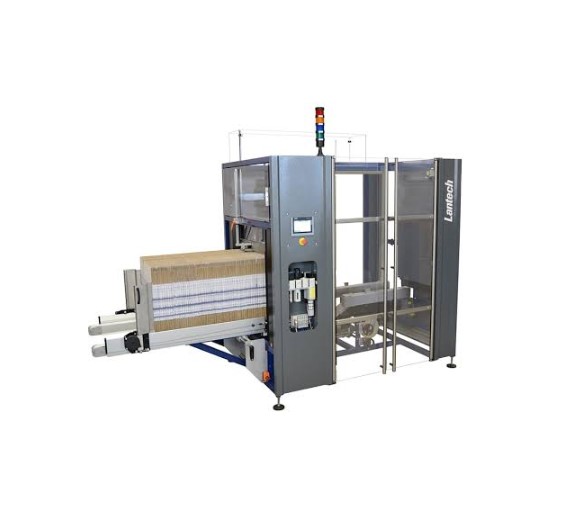
Automated case erecting plays an important role in modern packaging lines by converting flat corrugated blanks into properly formed boxes ready for filling and sealing. The process may appear straightforward, but accurate blank feeding, case opening, flap folding, and bottom sealing all need to work together to maintain consistent production. The Lantech case erector is an example of this type of packaging equipment, with systems designed to form square cases while controlling the carton throughout the erecting process. Understanding how these machines work and why individual components matter can help packaging teams identify maintenance requirements and reduce avoidable interruptions.
What Is a Case Erector?
A Lantech case erector is an automated packaging machine that takes flat, pre-cut corrugated case blanks and opens them into three-dimensional boxes. Depending on the machine configuration, the bottom flaps are then folded and sealed with tape, hot-melt adhesive or another closing method.
The process replaces or reduces manual box formation, which can be useful for operations handling significant packaging volumes. Lantech’s current case erector range includes machines with different throughput levels, case-size capabilities and sealing configurations. Some models are designed for smaller production environments, while modular systems can reach speeds of up to 30 cases per minute.
The primary objective is not simply to open a carton. A properly functioning machine must produce a stable, square case that can move reliably into downstream filling, sealing, palletising and wrapping operations.
Why Case Squareness Matters
Lantech case erector geometry has a direct effect on packaging performance. A carton with uneven sides or poorly formed corners may create problems during filling and pallet stacking.
Lantech reports that formed cases can lose approximately 30% of their stacking strength when their sides are not aligned. Square cases can therefore provide better structural support when products are packed and stacked.
Squareness also matters for automated equipment downstream. Cases that are not properly aligned can create positioning problems for case packers, sealers and conveying systems. Maintaining consistent dimensions from one case to the next helps the packaging line operate with fewer interruptions.
How a Case Erector Forms a Box
The case-forming process consists of several coordinated stages. Flat blanks are first stored in a magazine, where the machine’s feeding system separates and delivers individual blanks.
A pickup mechanism then pulls a blank from the magazine and opens it into its intended rectangular shape. The case needs to be positioned accurately at this stage because the geometry established during opening affects the rest of the process.
The bottom flaps are subsequently folded in sequence before the case reaches the sealing section. Depending on the equipment, tape or adhesive can secure the bottom. The completed case then moves toward the next stage of the packaging line.
Lantech describes its case erecting process as maintaining control over the case from blank pickup through flap folding and sealing.
The Role of the Box Holder
Individual components can have an important mechanical function even when they appear relatively simple. The product referenced in the supplied URL is a Lantech Case Erector Box Holder, manufacturer part number 30190212.
The listed component is intended to help keep boxes secured during the forming process. According to the product information, it supports consistent case positioning and can help reduce problems such as cartons tipping, folding incorrectly or jamming.
A component that helps maintain carton position is important because movement during forming can affect flap alignment and case geometry. If a box shifts at the wrong stage, the resulting carton may not meet the dimensional requirements of the downstream equipment.
For maintenance teams, this demonstrates why seemingly small components should not be overlooked when diagnosing recurring case-forming problems.
Common Causes of Case Erector Problems
Packaging equipment can experience interruptions for several reasons. Lantech identifies four common sources of case erector jams: incorrect blank feeding, irregularities in carton blanks, mechanical forces involved in opening and folding, and the transportation of formed cases through the machine.
Carton quality is particularly important. Variations in dimensions, board thickness, moisture conditions and blank construction can influence how consistently a case opens.
Machine adjustments are another consideration. A case erector must be configured for the dimensions and characteristics of the cartons being processed. Incorrect settings can place additional stress on components or prevent the case from being formed correctly.
Regular inspection can help identify wear before it becomes a production-stopping failure.
Why Replacement Components Matter
Industrial packaging machines contain multiple moving and contact components that experience repeated mechanical loads. Over time, parts can wear, become misaligned or require replacement.
Using the correct replacement component is important because packaging equipment is designed around specific dimensions, attachment points and operating characteristics. The referenced Box Holder 30190212 is listed with manufacturer SKU 30190212 and a specific equipment compatibility designation.
Maintenance teams should therefore verify the machine model, serial number and manufacturer part number before ordering a replacement. The supplier also notes that some Lantech parts can have lead times determined by the machine’s specific serial number.
This verification step can help prevent ordering an incompatible component and reduce delays during maintenance.
Choosing a Case Erector for Production Needs
Case erector selection should be based on more than maximum speed. Packaging teams should consider case dimensions, carton styles, available floor space, sealing requirements, changeover frequency and integration with other equipment.
For example, the Lantech C300 is specified for up to 10 cases per minute, while the C400 is specified for up to 8 cases per minute. Both are designed around square-case formation and include features intended to simplify case loading and adjustment.
Higher-volume operations may require modular equipment capable of handling larger production requirements. Lantech’s C Modular range is designed for output of up to 30 cases per minute and can be configured for different case sizes and closing methods.
The correct machine therefore depends on the complete packaging application rather than speed alone.
Maintenance Practices That Support Reliability
Preventive maintenance is important for equipment that operates repeatedly throughout a production shift. Operators and maintenance teams should inspect areas involved in blank feeding, case positioning, flap folding, sealing and conveying.
Cleaning can also be important because accumulated dust, paper fibres and adhesive residue may interfere with moving components or sensors. Mechanical components should be inspected according to the manufacturer’s maintenance recommendations, with worn or damaged parts replaced using appropriate specifications.
Keeping records of recurring faults can provide additional insight. If the same case position repeatedly shifts or a particular carton size produces jams, the issue may indicate a component, adjustment or material problem rather than an isolated machine fault.
Conclusion
Automated case erecting depends on precise coordination between carton blanks, machine settings and individual mechanical components. A properly formed square case provides a stronger foundation for filling, sealing, stacking and transportation, while accurate component positioning can help maintain consistent production.
For maintenance teams, understanding the function of individual machine parts is equally important. Components such as the Box Holder 30190212 contribute to keeping cartons properly positioned during formation, making correct identification, inspection and replacement an important part of maintaining reliable packaging operations.
