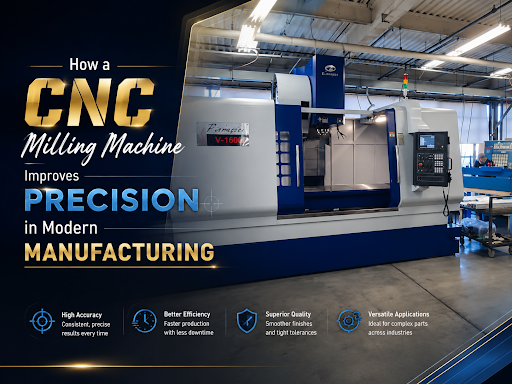
Manufacturing industries today demand exceptional precision, faster production cycles, and consistent quality to remain competitive. From automotive and aerospace components to medical devices and industrial equipment, manufacturers rely on advanced machining technologies to produce complex parts with tight tolerances. Among these technologies, the CNC milling machine has become one of the most important tools for achieving high levels of accuracy, repeatability, and production efficiency.
Unlike conventional machining methods that require extensive manual operation, CNC milling uses computer-controlled programming to automate cutting operations. This allows manufacturers to produce intricate components with minimal human error while maintaining consistent quality across large production runs. As industries continue to embrace automation, CNC milling remains a cornerstone of modern precision manufacturing.
What Is a CNC Milling Machine?
A CNC milling machine is a computer-controlled machining system that removes material from a workpiece using rotating cutting tools. The machine follows programmed instructions, commonly known as G-code, to perform precise cutting, drilling, slotting, contouring, and surface finishing operations across multiple axes.
These machines can process various materials, including:
- Aluminum
- Steel
- Stainless steel
- Titanium
- Brass
- Plastics
- Composite materials
Because of their versatility, CNC milling machines are widely used across industries that require highly accurate and repeatable manufacturing processes.
Why CNC Milling Machines Are Important
A CNC milling machine offers numerous advantages compared to traditional manual machining methods.
Some of the primary benefits include:
- High machining accuracy
- Excellent repeatability
- Reduced production errors
- Faster manufacturing cycles
- Greater flexibility for complex parts
- Improved surface finishes
- Lower material waste
These advantages enable manufacturers to meet demanding production schedules while maintaining consistent product quality across every batch.
How CNC Milling Works
The CNC milling process follows several key stages.
Design and Programming
Engineers first create a digital model using Computer-Aided Design (CAD) software. The design is then converted into machine instructions using Computer-Aided Manufacturing (CAM) software, generating G-code that directs the machine’s movements.
Machine Setup
The workpiece is securely mounted on the machine table, cutting tools are installed, and machine parameters are configured before machining begins.
Automated Machining
Once the program starts, the machine automatically controls spindle movement, tool changes, feed rates, and cutting paths to produce the desired component with exceptional precision.
Applications Across Industries
Modern manufacturing depends heavily on CNC milling machine technology for producing precision components.
Common industries include:
- Aerospace
- Automotive
- Medical equipment
- Electronics
- Defense
- Energy
- Industrial machinery
These industries require parts that meet strict dimensional tolerances while maintaining consistent quality throughout production.
Common Milling Operations
A CNC milling machine can perform a wide variety of machining operations, including:
- Face milling
- End milling
- Slot milling
- Pocket milling
- Drilling
- Tapping
- Contour milling
- Surface finishing
The ability to complete multiple operations within a single setup improves productivity while reducing handling time and setup errors.
Factors to Consider When Choosing a CNC Milling Machine
Selecting the right equipment depends on several important considerations.
These include:
- Machine size
- Number of axes
- Spindle speed
- Table capacity
- Tool changer capacity
- Material compatibility
- Required precision
- Production volume
Understanding these factors helps manufacturers choose equipment that aligns with both current production requirements and future growth plans.
Importance of CNC Vertical Machining
Many manufacturing facilities utilize CNC vertical machining because it offers an efficient solution for producing complex components with high accuracy. Vertical machining centers are especially effective for operations such as drilling, pocketing, contouring, and surface milling while providing excellent accessibility during setup and maintenance.
Their versatility makes them suitable for both prototype development and high-volume production environments.
Best Practices for Maximizing Performance
To achieve consistent machining quality, manufacturers should follow several best practices.
These include:
- Regular machine maintenance
- Proper tool selection
- Optimized cutting parameters
- Accurate workpiece fixturing
- Routine calibration
- Effective coolant management
- Continuous operator training
Following these practices helps extend machine life while improving production efficiency and product quality.
Future Trends in CNC Milling
Advancements in digital manufacturing continue to reshape CNC machining technologies.
Emerging trends include:
- AI-assisted machining
- Smart factory integration
- Predictive maintenance
- Advanced automation
- Real-time process monitoring
- Multi-axis machining
- Digital twins for production planning
These innovations enable manufacturers to improve productivity, reduce downtime, and maintain higher levels of machining precision in increasingly competitive markets.
Conclusion
A CNC milling machine has become an essential part of modern manufacturing by delivering exceptional precision, repeatability, and production efficiency. Its ability to produce complex components with minimal variation makes it an indispensable solution across industries ranging from aerospace to medical manufacturing. By selecting the right equipment, following proven machining practices, and embracing technological advancements, manufacturers can improve product quality while optimizing operational performance. Working with Campro USA can help manufacturers explore advanced machining solutions that support long-term productivity and precision. As manufacturing continues to evolve toward greater automation and smarter production systems, CNC milling technology will remain at the forefront of precision engineering.
